
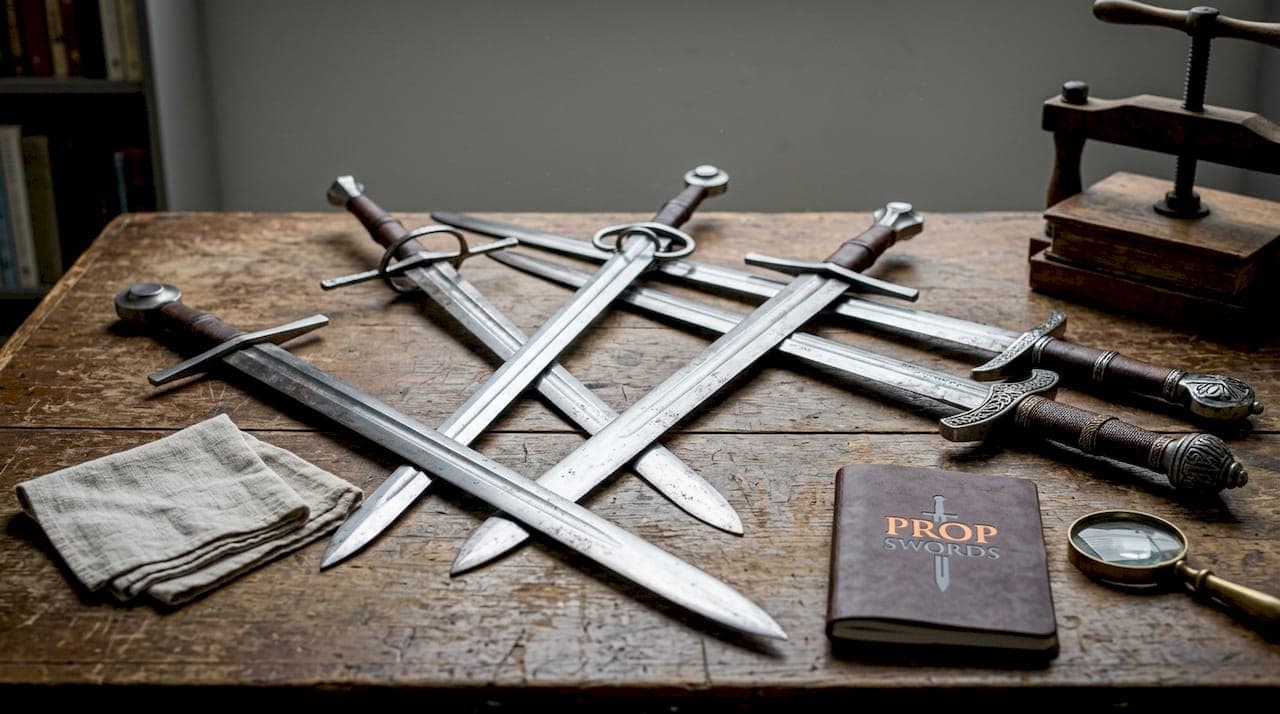
Picture a medieval battlefield and you probably imagine one kind of sword. The reality is far more complex. Medieval swords evolved across centuries into dozens of distinct forms, each shaped by warfare demands, metallurgical advances, and cultural shifts. The Oakeshott typology alone classifies double-edged straight blades from Type X through Type XXII, based on blade shape, fuller length, and taper. This guide walks you through the major sword types, how they were built, and what that knowledge means for collectors and enthusiasts today.
Table of Contents
- Why are there so many types? The evolution of swords
- How are swords classified? Major medieval typologies explained
- Core sword types examined: Forms, uses, and history
- Inside the sword: Anatomy and construction techniques
- Applying sword knowledge: For collectors and enthusiasts
- Explore authentic replicas and deepen your expertise
- Frequently asked questions
Key Takeaways
| Point | Details |
|---|---|
| Swords evolved for function | Medieval sword diversity reflects advances in warfare, technology, and culture. |
| Typologies aid identification | Systems like Oakeshott and Elmslie help collectors and historians classify swords by era and design. |
| Construction was sophisticated | Swords were crafted with advanced metallurgy for optimal balance, strength, and utility. |
| Knowledge benefits collectors | Understanding sword types and construction helps collectors authenticate and appreciate their finds. |
Why are there so many types? The evolution of swords
Swords did not stay the same because warfare did not stay the same. From the Viking Age through the Late Medieval period, fighters faced new threats, new armor, and new tactical situations. Each shift pushed smiths and warriors to rethink blade geometry, weight distribution, and grip design.
The evolution of medieval swords tracks this progression clearly. Early Viking-era blades prioritized wide cutting edges for slashing unarmored opponents. As plate armor spread in the 14th and 15th centuries, swords grew longer, narrower, and more pointed to find gaps in the steel. Cultural exchange along trade routes also introduced new forms from the Middle East and Asia into European workshops.
"The Oakeshott typology is the standard classification system for medieval European swords, organizing double-edged straight blades by blade morphology, fuller length, cross-section, and taper across more than a dozen distinct types."
Typologies like Oakeshott, Geibig, and Petersen were developed to make sense of this diversity. They are not just academic tools. They help collectors, reenactors, and enthusiasts place a sword in its correct historical moment and understand why it looks the way it does.
- Viking Age (8th to 11th century): Broad, single-fullered blades optimized for cutting
- High Medieval (11th to 13th century): Longer, more tapered blades as mail armor spread
- Late Medieval (14th to 15th century): Narrow, stiff blades designed to defeat plate armor
- Transitional (15th to 16th century): Complex hilts, thinner blades, early rapier forms emerging
How are swords classified? Major medieval typologies explained
With an understanding of the sword's evolutionary journey, let's see how historians and collectors classify them. Two systems dominate the conversation: the Oakeshott typology for double-edged swords and the Elmslie typology for single-edged blades.
The Oakeshott typology is complementary to systems like Geibig and Petersen, and experts note that single-edged swords were sometimes misclassified as knives for legal or cultural reasons, which complicates the historical record. The Elmslie typology fills that gap, covering single-edged types like the falchion and messer that Oakeshott does not address.
Exploring the full range of types of historical swords reveals just how specialized these systems are.
| Feature | Oakeshott typology | Elmslie typology |
|---|---|---|
| Blade edge | Double-edged | Single-edged |
| Era covered | 10th to 16th century | 13th to 16th century |
| Common types | Arming sword, longsword, greatsword | Falchion, messer, backsword |
| Classification basis | Blade shape, fuller, taper, cross-section | Blade curve, edge geometry, tip form |
| Primary use | Military and knightly swords | Civilian, infantry, utility blades |
Pro Tip: If you are researching a single-edged blade and trying to fit it into the Oakeshott system, you will hit a wall fast. Oakeshott was designed for double-edged swords. Reach for the Elmslie typology instead and you will get far more accurate results.
Core sword types examined: Forms, uses, and history
Now let's spotlight the sword types themselves and what made each distinctive in form and purpose.
| Sword type | Era | Blade length | Key features | Primary function |
|---|---|---|---|---|
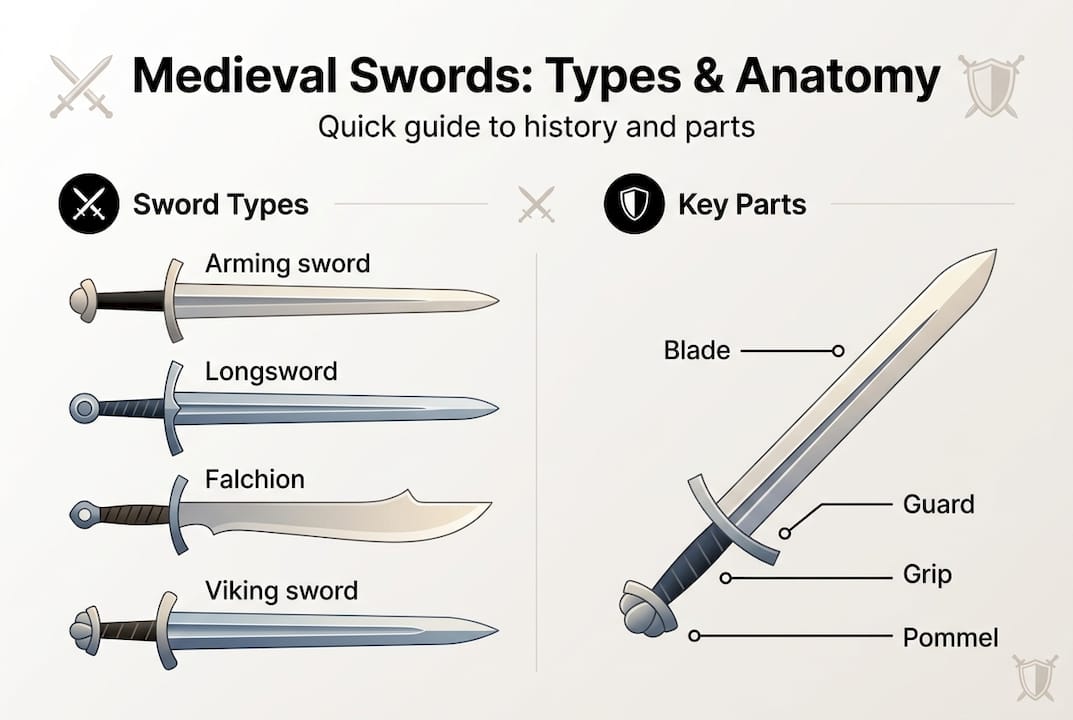
| Arming sword | 10th to 15th c. | 75 to 90 cm | Single-handed, cruciform hilt | Combat with shield |
| Longsword | 13th to 17th c. | 85 to 110 cm | Two-handed grip, tapered blade | Versatile military use |
| Viking sword | 8th to 11th c. | 70 to 85 cm | Wide fuller, rounded tip | Slashing, cavalry |
| Falchion | 13th to 16th c. | 60 to 80 cm | Single-edged, curved tip | Cleaving light armor |
| Messer | 14th to 16th c. | 60 to 90 cm | Single-edged, knife-style hilt | Infantry, civilian use |
| Greatsword | 15th to 17th c. | 120 to 160 cm | Two-handed, long ricasso | Battlefield formation use |
The arming sword was the standard knightly weapon from the 10th through 15th centuries, with an average mass of 1 to 1.5 kg and a total length of 90 to 105 cm. It was designed to be used with a shield and eventually evolved into the side-sword and rapier as fighting styles changed.
The falchion and messer represent the single-edged tradition. The falchion was a cleaving weapon effective against lightly armored opponents, while the messer served infantry and civilians from the 14th through 16th centuries. Both are often overlooked in favor of the more glamorous longsword, but they were widely used and highly practical.
What made each type unique at a glance:
- Arming sword: Balanced for one-handed use, versatile in cut and thrust
- Longsword: Long grip allowed half-swording techniques for armored combat
- Viking sword: Fuller reduced blade weight without sacrificing strength
- Falchion: Curved, heavy tip delivered powerful chopping blows
- Messer: Nagel (a small side projection on the guard) protected the hand in close fighting
- Greatsword: Ricasso (unsharpened section near the hilt) allowed gripping for tight-quarters leverage
For a deeper look at how these translate into modern replicas, the guide on historical sword replicas compares weight and length across four major types. You can also explore how these swords function in historical reenactment contexts.
Inside the sword: Anatomy and construction techniques
Appreciating sword types is enhanced by knowing how each one was made and the thought behind its construction.
Medieval smiths did not work with modern steel from the start. Here is how construction evolved:
- Early iron carburization: Wrought iron was heated in carbon-rich material to absorb carbon and become steel. This was slow and inconsistent.
- Pattern welding: Smiths twisted and folded iron rods of different carbon content together, creating a blade with a flexible core and harder edges. This technique is visible in many Viking sword blades.
- Crucible steel: Later medieval smiths gained access to higher-quality steel produced in controlled furnace environments, allowing more uniform blades.
- Differential heat treatment: The edge was quench-hardened for sharpness while the spine was tempered to stay flexible. This prevented catastrophic snapping in combat.
- Fuller grinding: The fuller (the groove running along the blade) was ground in to reduce weight without weakening the blade's structure.
The hilt was just as carefully engineered. A cruciform guard protected the hand from sliding blades, while the grip was built from wood wrapped in leather or wire for a secure hold. The pommel, which shifted from brazil-nut shapes in early swords to wheel forms in later ones, was not just decorative. It counterbalanced the blade and allowed fighters to shift their grip for different techniques.
Pro Tip: When assessing a replica or historical piece, check the pommel shape and guard style first. These components changed in recognizable patterns across eras and are among the easiest ways to date a sword and verify its type.
Understanding materials used in replica swords helps collectors evaluate quality, and the historical sword reproduction guide breaks down how modern makers replicate these ancient techniques.
Applying sword knowledge: For collectors and enthusiasts
Understanding swords academically is one thing, but putting that knowledge into practice as a collector or hobbyist is another.
Here is a practical process for identifying and assessing a sword type:
- Start with the blade edge: Is it single or double-edged? This determines which typology to use.
- Measure blade length and total length: These numbers narrow down the type significantly.
- Examine the fuller: Its length, depth, and position are key Oakeshott classification markers.
- Study the hilt: Guard shape, grip length, and pommel form all point to specific eras and types.
- Cross-reference with a typology chart: Match your observations to Oakeshott or Elmslie categories.
- Check the historical swords checklist: Expert criteria help you confirm your identification and assess collector value.
Common mistakes collectors make:
- Assuming all medieval swords are longswords: Most were arming swords or shorter utility blades
- Ignoring single-edged types: Falchions and messers are historically significant and often undervalued
- Overlooking hilt details: A mismatched pommel or guard can indicate a later replacement or a reproduction
- Confusing fantasy designs with historical forms: Many popular sword designs are creative inventions with no historical basis
- Skipping provenance research: Where a sword came from matters as much as what it looks like
The guide on how to buy collectible swords walks through the full purchasing process, and understanding the difference between fantasy swords and historical swords is essential before spending serious money on a piece.
Explore authentic replicas and deepen your expertise
You now have a solid foundation in medieval sword types, construction, and classification. The next step is seeing that knowledge reflected in real pieces you can hold, display, or add to your collection.

Propswords offers a wide range of historically inspired replica swords, from Viking-era blades to late medieval longswords, all crafted with attention to the details that matter to serious enthusiasts. Whether you are building a display collection or looking for an accurate reenactment piece, the sword reproduction guide is a great companion resource. Browse the full catalog and use what you have learned here to spot the details that separate a quality replica from a generic prop. Free shipping within the USA makes it easy to start or expand your collection today.
Frequently asked questions
What is the difference between an arming sword and a longsword?
An arming sword is a one-handed straight sword designed for use with a shield, while a longsword features a longer grip built for two-handed use and greater reach in combat.
How do collectors identify the type of a medieval sword?
Collectors use the Oakeshott typology to match blade shape, fuller length, and cross-section to specific types, which also helps place the sword in its correct historical period.
Why are some medieval swords single-edged and others double-edged?
Single-edged swords like the falchion were built for powerful cleaving against lightly armored opponents, while double-edged blades offered more versatility for both cutting and thrusting in different combat situations.
What roles did the hilt and pommel play in medieval sword use?
The cruciform guard protected the hand from opposing blades, while the pommel counterbalanced the blade's weight and allowed fighters to shift their grip for different combat techniques.