
TL;DR:
- Many iconic anime swords are inspired by real Japanese legendary blades with mythological significance.
- Sword design in anime reflects character traits, power levels, and thematic symbolism.
- Collectors seek replicas for their cultural history, visual impact, and storytelling connection.
Most anime fans assume the oversized, glowing blades in their favorite series are pure fantasy. They are not. Many of the most iconic anime swords trace their roots directly to real Japanese legendary blades, some over a thousand years old. The Dōjigiri, a sword recognized as a National Treasure of Japan, inspired entire generations of demon-slaying motifs in anime storytelling. Understanding where these weapons come from changes how you see them, whether you are watching a battle scene or deciding which replica deserves a place on your shelf.
Table of Contents
- Ancient legends and real swords: The origin story
- Evolution of sword design in anime: Elegance versus power
- Cultural significance: Swords as character, soul, and storytelling device
- Collectors, cosplay, and real-world impact
- The misunderstood beauty and challenge of anime swords
- Explore authentic anime sword replicas with Propswords
- Frequently asked questions
Key Takeaways
| Point | Details |
|---|---|
| Legend inspires fiction | Real Japanese swords and folk tales heavily influence iconic anime sword designs and stories. |
| Design reflects symbolism | Anime sword styles embody elegance, power, and character depth, mixing tradition with fantasy. |
| Impact beyond screen | Sword replicas, cosplay, and collector fandom show how anime swords shape real-world culture and community. |
| Collector wisdom | Understanding history and symbolism leads to smarter choices in anime sword collecting and cosplay. |
Ancient legends and real swords: The origin story
The connection between anime swords and Japanese history runs deeper than most fans realize. Long before manga artists sketched their first blade, Japan had its own mythology of legendary swords tied to gods, demons, and imperial power. These stories did not just inspire anime. They became the structural DNA of how anime portrays swords today.
Three blades stand out as the most influential:
- Dōjigiri Yasutsuna: Forged by the swordsmith Yasutsuna, this blade is credited with slaying the demon Shuten-doji, one of Japan's most feared oni. It is now a National Treasure, held in the Tokyo National Museum. Its legend of a warrior blade defeating supernatural evil is the blueprint for nearly every demon-slaying sword in anime.
- Kusanagi-no-Tsurugi: One of the three Imperial Regalia of Japan, this sword was said to have been found inside an eight-headed serpent. Its name translates roughly to "grass-cutting sword," referencing a legend where it was used to cut grass during a fire to save a hero. It appears in various forms across anime, most famously in Naruto.
- Onikirimaru: Literally meaning "demon cutter," this blade is famous in Japanese folklore for severing the arm of a demon. The image of a sword that can cut through supernatural beings became a staple of anime storytelling.
"The legends surrounding these blades are not decorative history. They are the emotional and narrative engine that powers anime sword mythology."
What is surprising is how directly these legends translate. The demon-slaying motifs in modern anime, from Demon Slayer's Nichirin blades to Inuyasha's Tessaiga, follow the same story logic as Dōjigiri and Onikirimaru. A hero, a supernatural threat, and a blade that bridges the human and spirit worlds. The formula is ancient. The animation is new.
This matters for collectors because a replica is never just a prop. It carries centuries of mythological weight, whether the buyer knows it or not.
Evolution of sword design in anime: Elegance versus power
Anime sword design is not random. Every stylistic choice, from a slender katana to a blade the size of a car door, communicates something specific about the character wielding it.
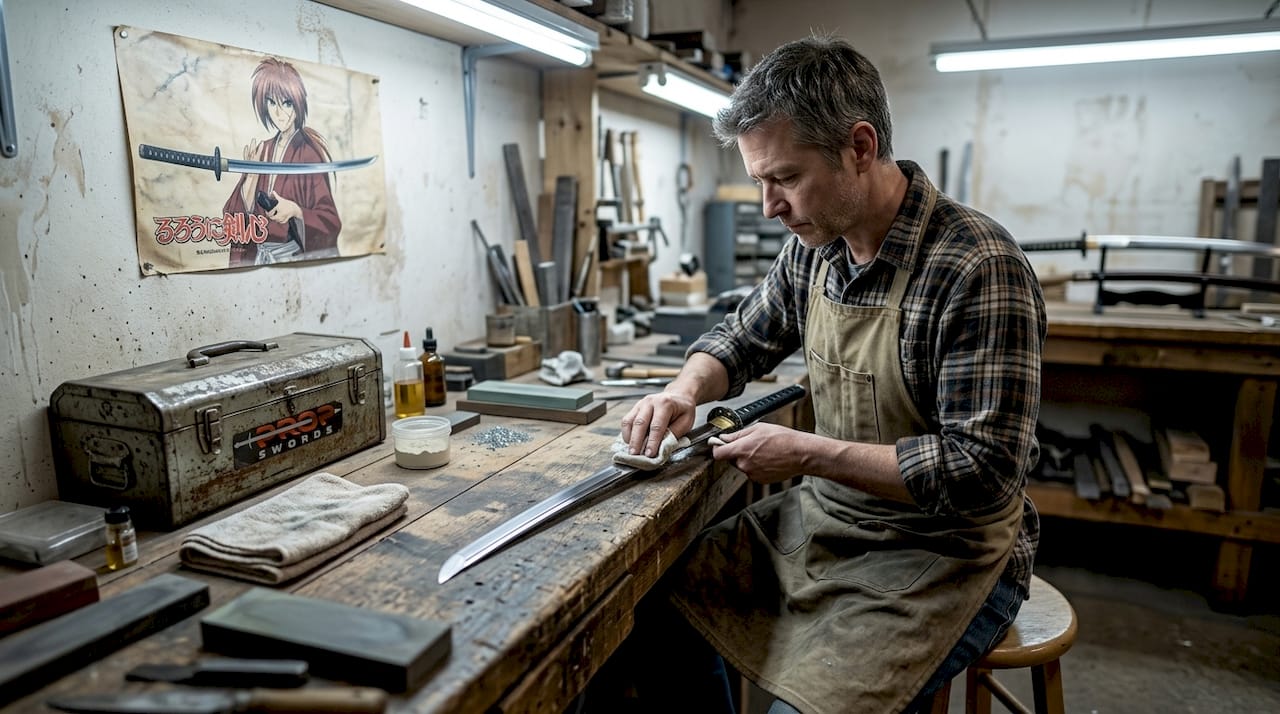
The katana represents tradition, precision, and soul. Series like Bleach and Rurouni Kenshin built entire philosophies around the katana's elegance. In Bleach, every Soul Reaper's sword has a unique spirit called a Zanpakuto, making the blade literally an extension of the character's identity. Rurouni Kenshin's reverse-blade sword is a visual argument: a weapon designed not to kill, reflecting Kenshin's vow of non-violence.
At the opposite extreme, greatswords like Guts' Dragon Slayer from Berserk reject elegance entirely. The Dragon Slayer is described as a slab of iron, not a sword. It is impractical by design, and that impracticality is the point. It communicates raw, almost inhuman physical power.
| Sword type | Example | Core symbolism |
|---|---|---|
| Katana | Zangetsu (Bleach) | Soul, tradition, elegance |
| Greatsword | Dragon Slayer (Berserk) | Brute force, survival |
| Fantasy blade | Ea (Fate series) | Divine power, mystery |
| Dual blades | Elucidator (SAO) | Speed, duality, adaptability |
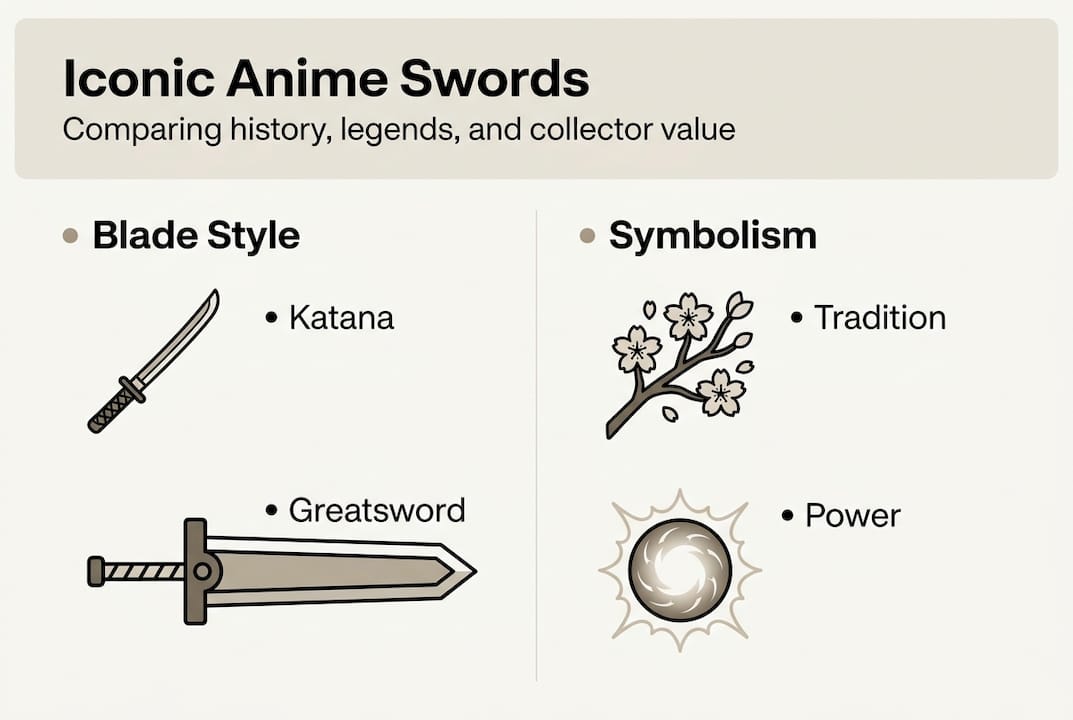
Fantasy swords with special abilities, like Fate's Ea or Sword Art Online's Elucidator, add a third dimension: magical origin. These anime sword designs range from katana for elegance to greatswords for raw power to fantasy blades with unique abilities, each telling a different story about its wielder.
Pro Tip: When choosing a sword for cosplay display, match the blade type to the character's personality. A greatsword replica reads differently than a katana, even on a shelf.
The shift from purely historic designs to fantastical ones tracks with anime's growing confidence in world-building. Early series stayed close to real Japanese sword forms. Later series invented entirely new weapon categories. For collectors using an anime sword buying checklist, understanding this evolution helps narrow down which era and style speaks to you most.
Cultural significance: Swords as character, soul, and storytelling device
Anime swords are rarely just weapons. They are characters in their own right.
The most memorable blades in anime history carry meaning that goes beyond cutting power. They reflect the inner life of the person holding them, and sometimes they push back.
Here is how anime uses swords as storytelling devices:
- Identity markers: A character's sword tells you who they are before they speak. Kenshin's reverse-blade katana signals his pacifism. Guts' Dragon Slayer signals his refusal to accept limits.
- Spiritual connection: In many series, the bond between wielder and blade is literal. Bleach's Zanpakuto spirits communicate with their owners. This mirrors real Japanese beliefs about swords holding spiritual energy, called tamashii.
- Narrative catalysts: Swords drive plot. They are broken to signal defeat, reforged to signal growth, and passed down to signal legacy. Inuyasha's Tessaiga is literally inherited from his father, making every battle a conversation with ancestry.
- Conflict and moral weight: The oversized, impractical blades in series like Berserk contrast with elegant katana to highlight a core tension: is a sword a tool of the soul or simply an instrument of destruction?
"When a sword breaks in anime, it is never just about the metal. It is about what the character believed in."
This is why the storytelling role of swords in anime is so layered. Writers use blade design, condition, and history as shorthand for emotional states that would take pages of dialog to explain. A cracked blade in a climactic scene communicates doubt, exhaustion, and stakes faster than any monologue.
For collectors, this depth is part of the appeal. Owning a replica of Tessaiga or Zangetsu is not just about the object. It is about carrying a piece of that narrative weight into the real world.
Collectors, cosplay, and real-world impact
The cultural weight of anime swords has translated into a massive real-world market. Collectors and cosplayers worldwide actively seek out replicas, and certain series dominate demand year after year.
Rankings consistently place Berserk, Inuyasha, and Bleach at the top of collector and cosplay interest, with their cultural impact visible in replica sales and global fandom events.
| Series | Iconic sword | Collector appeal |
|---|---|---|
| Berserk | Dragon Slayer | Extreme size, raw design |
| Inuyasha | Tessaiga | Transformation, emotional legacy |
| Bleach | Zangetsu | Spiritual depth, visual impact |
| Demon Slayer | Nichirin blades | Color variety, current popularity |
What drives this demand? A few key factors:
- Visual distinctiveness: These swords are immediately recognizable, which makes them powerful cosplay statements.
- Emotional connection: Fans grew up with these series. Owning a replica is a way of holding onto that connection.
- Display value: High-quality replicas are genuine conversation pieces, especially for famous sword replicas that capture fine design details.
Pro Tip: Before buying any replica, check whether it is officially licensed or a high-quality third-party reproduction. Material matters too. Zinc alloy replicas look great for display, while resin versions are lighter for cosplay. Explore top collectible anime swords to compare your options before committing.
The cosplay market has also pushed replica quality upward. Fans who carry swords to conventions demand accuracy and durability. This has raised the bar across the industry. If you are new to collecting, a guide on choosing anime sword replicas can save you from costly mistakes early on.
The misunderstood beauty and challenge of anime swords
Here is something most collector guides will not tell you: the majority of fans who buy anime sword replicas have no idea what they are actually holding.
That is not a criticism. It is an observation about how fandom works. People fall in love with the visual first, the story second, and the history almost never. But the history is where the real richness lives. A Dragon Slayer replica is striking on a wall. It becomes extraordinary when you understand that its design philosophy connects back to centuries of Japanese folklore about blades that transcend human limits.
We think the best collectors are the ones who treat their pieces as artifacts, not accessories. That shift in perspective changes everything, from how you display a sword to how you talk about it. It also makes you a more discerning buyer. When you know why a blade looks the way it does, you can spot the difference between a replica that honors the source material and one that just copies the shape.
The challenge is that most content about anime swords stays at the surface. It lists the coolest blades without explaining why they matter. True appreciation requires digging into the myth, the design intent, and the cultural context. A good starting point is learning how to choose display replica swords with that deeper knowledge in mind.
Explore authentic anime sword replicas with Propswords
Now that you understand the history and meaning behind these iconic blades, the next step is finding replicas that do them justice.
At Propswords, we offer a wide selection of anime sword replicas built for collectors and cosplayers who care about quality and accuracy. Whether you are looking for a display piece or a convention-ready prop, our catalog covers the most iconic blades in anime history. We also offer free shipping within the USA. If you are shopping for someone else, our guide on how to select anime sword gifts will help you find the perfect match for any fan or collector on your list.
Frequently asked questions
What are the historical origins of anime swords?
Many anime swords draw directly from real Japanese legends and historic blades. The Dōjigiri and Kusanagi are two of the most influential, inspiring demon-slaying motifs that appear across dozens of modern anime series.
Which anime swords are most popular among collectors?
Replicas from Berserk, Bleach, and Inuyasha rank consistently at the top of collector and cosplay demand, driven by their iconic visual design and deep emotional connection to fans worldwide.
Why do anime swords often feature exaggerated designs?
Oversized, impractical blades are a deliberate design choice to communicate themes of raw power and individuality, standing in sharp contrast to the precision and elegance of traditional katana forms.
How do I choose a quality anime sword replica?
Look for officially licensed replicas or reputable third-party manufacturers, verify the material used (zinc alloy for display, resin for cosplay), and always check seller reviews before purchasing to ensure durability and accuracy.