

TL;DR:
- Selecting a medieval sword depends on purpose, whether display, cosplay, collection, or HEMA use.
- Key features of a quality sword include full tang construction, high-carbon steel, proper heat treatment, and correct balance.
- Avoid low-quality or poorly specified swords by checking for detailed specs, reputable brands, and independent reviews.
Finding the right medieval sword feels impossible when hundreds of replicas flood the market, most of them promising authenticity but delivering little more than wall decoration. Whether you're building a serious collection, suiting up for cosplay, or hunting for a centerpiece display piece, the wrong choice wastes money and leaves you with a blade that disappoints. This guide walks you through every decision point, from sword type to steel grade, so you can shop with confidence instead of guesswork. The criteria here apply whether you're buying your first sword or your fifteenth.
Table of Contents
- Understanding medieval sword types and uses
- Key criteria: What makes a quality medieval sword?
- Step-by-step: How to evaluate and select your medieval sword
- Avoiding common mistakes and recognizing red flags
- What most guides miss about collecting medieval swords
- Find your medieval sword: Shop and explore more
- Frequently asked questions
Key Takeaways
| Point | Details |
|---|---|
| Clarify sword purpose | Define whether your ideal sword is for display, cosplay, collection, or martial arts before starting your search. |
| Focus on construction | Prioritize full tang construction, high-carbon steel, and reputable brands to ensure quality. |
| Spot red flags | Beware of stainless steel for function, rat-tail tangs, and vague sellers when buying a sword. |
| Balance authenticity and budget | Consider your personal interests and the role of the sword to find the best fit for your collection or cosplay. |
Understanding medieval sword types and uses
Now that you know what makes choosing a sword tricky, let's break down the kinds you might encounter. Medieval swords fall into three broad categories, and knowing which one fits your goal saves you from expensive mistakes.
Historical replicas aim to reproduce actual swords from specific periods and regions. Think a 13th-century knightly sword or a Viking Age piece with documented proportions. These appeal to serious collectors, historians, and HEMA (Historical European Martial Arts) practitioners who care about accuracy.
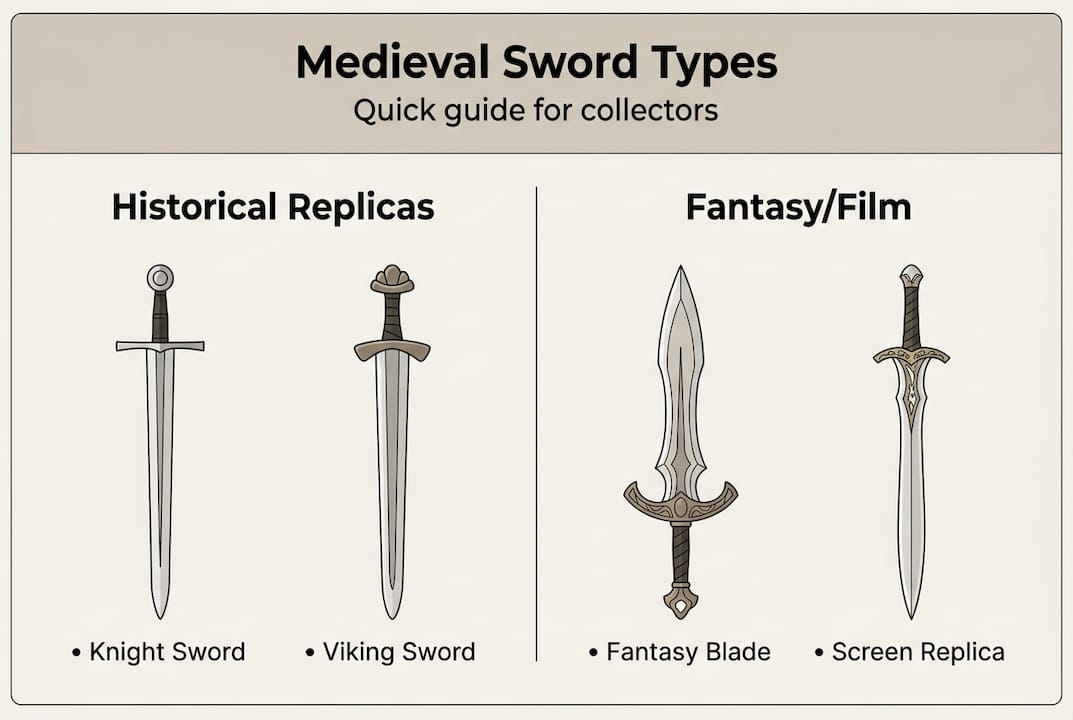
Fantasy-inspired designs take creative liberties, drawing from game art, mythology, or pure imagination. These are popular among cosplayers and display collectors who prioritize visual impact over strict accuracy. If you want to understand the difference in depth, the breakdown of fantasy vs historical swords is worth reading before you commit.
Film and game replicas recreate specific screen or game weapons. Demand for these spikes after major releases, but quality varies wildly between licensed and unlicensed versions.
Your intended use shapes everything else. Display swords can be lighter, use decorative finishes, and tolerate stainless steel blades. Cosplay swords need to be safe, lightweight, and durable enough for convention handling. Functional or HEMA swords require quality steel construction with full tang, proper heat treatment, and correct balance.
Here's a quick comparison of the most common sword types:
| Sword type | Typical weight | Primary use | Key feature |
|---|---|---|---|
| Longsword | 2.5–3.5 lbs | HEMA, display, collection | Two-handed grip |
| Arming sword | 2.0–2.8 lbs | Collection, cosplay | Versatile one-hander |
| Falchion | 2.2–3.0 lbs | Display, cosplay | Single-edge curve |
| Greatsword | 5.0–8.0 lbs | Display, HEMA | Long reach, two-handed |
| Fantasy sword | Varies | Cosplay, display | Unique visual design |
Choosing a style also means matching the historical period or character to your interest. The evolution of medieval swords shows how blade geometry changed across centuries, which matters if historical accuracy is your goal. A Viking sword looks and handles very differently from a late medieval estoc, and buying the wrong one for your cosplay or collection theme is a mistake that's easy to avoid with a little research.
Key considerations when choosing your sword type:
- Display only: Prioritize aesthetics, finish, and visual accuracy
- Cosplay: Prioritize weight, safety, and character accuracy
- Collection: Prioritize historical accuracy, provenance, and construction quality
- HEMA or martial arts: Prioritize full tang, high-carbon steel, and correct balance
Key criteria: What makes a quality medieval sword?
With sword categories in mind, let's get specific about what distinguishes a truly quality piece. Construction quality is where most buyers get burned, especially when shopping online.
The single most important structural feature is full tang construction. The tang is the part of the blade that extends into the handle. A full tang runs the entire length of the grip, giving the sword structural integrity. A rat-tail tang is a thin spike welded or attached to the blade, and it's a shortcut that compromises durability. Under stress, rat-tail tangs snap. Avoid them entirely.
For steel, high-carbon steel grades like 1050 to 1095 are the standard for quality replicas. These grades offer the right combination of hardness and flexibility. Stainless steel, despite looking polished, is brittle under impact and unsuitable for anything beyond static display.
Heat treatment matters just as much as steel grade. A properly treated blade reaches 54 to 58 HRC (Rockwell hardness), which keeps the edge sharp while allowing the spine to flex rather than shatter. Oil-quenched and tempered blades are the benchmark.
Balance is often overlooked. The point of balance (PoB) should sit 3 to 6 inches from the guard. A sword with poor balance feels clumsy, fatigues the wrist quickly, and handles nothing like a real weapon.
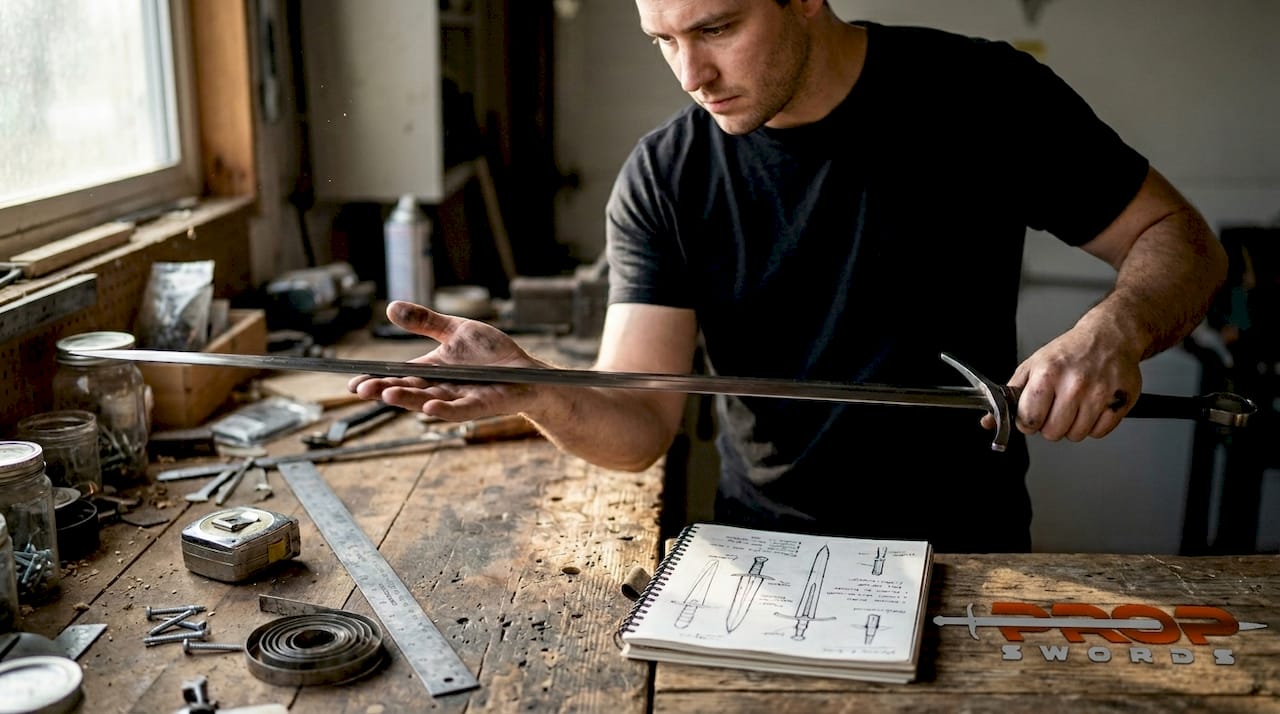
Comparison: Quality sword vs. budget sword
| Feature | Quality sword | Budget sword |
|---|---|---|
| Tang | Full tang | Rat-tail tang |
| Steel | 1050–1095 high-carbon | Stainless steel |
| Heat treatment | Oil-quenched, 54–58 HRC | None or inconsistent |
| Point of balance | 3–6 inches from guard | Unpredictable |
| Finish | Consistent, clean | Sloppy, uneven |
Here's what to check when evaluating any sword:
- Confirm full tang in product specs or photos
- Verify steel grade (1050, 1060, 1075, or 1095)
- Check for heat treatment details
- Look for PoB measurement in the listing
- Inspect finish photos for consistency
Understanding why sword materials matter gives you a deeper foundation for evaluating any listing. You can also use a historical swords checklist as a quick reference when comparing options.
Pro Tip: If a listing doesn't mention steel grade or tang type, treat it as a red flag. Reputable sellers always include this information because it's a selling point, not a secret.
Step-by-step: How to evaluate and select your medieval sword
Now that you know exactly what to look for in a quality sword, let's turn that knowledge into action with a clear step-by-step process.
-
Define your purpose first. Display, cosplay, collection, or HEMA each demands different specs. Write down your primary use before you browse anything.
-
Research reputable brands. Albion Swords, Windlass Steelcrafts, Darksword Armory, Deepeeka, and Kult of Athena are consistently respected in the collector community. These brands publish detailed specs and stand behind their products.
-
Inspect materials and construction. For online purchases, zoom into product photos. Look for the tang inside handle cutaway shots. Read the full spec sheet, not just the headline description.
-
Read independent reviews. Avoid relying solely on the seller's page. Forums like MyArmoury and independent review sites give you unfiltered buyer experiences. Look for reviews that mention handling, not just appearance.
-
Balance authenticity with budget. A $150 sword and a $600 sword serve different purposes. Don't overspend on a display piece, but don't underspend on a functional one. The top replica swords for collectors covers options across price points.
-
Check return and warranty policies. A seller confident in their product offers clear return windows. Vague or absent policies are a warning sign.
The historical sword reproduction guide goes deeper on what separates a well-made reproduction from a decorative prop, which is useful reading before finalizing any purchase.
Pro Tip: When buying online, search for the exact model name plus "review" or "unboxing" on YouTube. Real handling footage tells you more than any product photo.
One thing most buyers skip is checking the oil-quenched blade standard for the specific model they're considering. A sword can use the right steel grade but still fail if heat treatment was inconsistent during production.
Avoiding common mistakes and recognizing red flags
Having walked through the steps, it's crucial to stay alert for common traps along the way.
The most frequent mistake is buying on looks alone. A sword can have stunning engravings, a dramatic finish, and an impressive weight, and still be structurally weak. Marketing photos are designed to sell, not to inform.
Watch for these red flags:
- No steel grade listed: Reputable sellers always disclose this
- "Stainless steel" for a functional sword: Fine for display, dangerous for handling
- Price too low for the claimed quality: A battle-ready longsword under $100 is almost always a disappointment
- No return policy or vague terms: Signals low confidence in the product
- Lack of buyer photos or independent reviews: Studio photos hide flaws that real-world shots reveal
- Vague tang description: "Strong handle" or "durable grip" without specifying full tang is a dodge
Real collector horror stories follow a pattern. A buyer picks a sword based on its movie-accurate look, skips the spec sheet, and receives a blade that bends on the first swing or a hilt that wobbles after a week on the wall. These aren't rare outcomes with budget swords.
"Independent guides emphasizing construction over aesthetics consistently outperform vendor-driven recommendations when it comes to long-term buyer satisfaction."
Vendor bias is real. Some sellers push their own brand heavily without disclosing limitations. Cross-reference any strong recommendation with a neutral source. The historical sword replicas comparison and the medieval sword display guide both offer balanced perspectives that help you cut through marketing noise.
One underrated mistake is ignoring fittings. The guard, grip, and pommel matter for both aesthetics and function. Loose fittings rattle, shift under use, and signal rushed manufacturing. Tap the pommel and wiggle the guard before buying in person, or ask the seller directly if purchasing online.
What most guides miss about collecting medieval swords
Most sword guides focus on specs and brands, which is useful but incomplete. What they rarely address is the personal dimension of collecting.
A sword's story matters as much as its steel grade. A historically accurate reproduction of a 14th-century knightly sword connects you to a real moment in history. A fantasy piece tied to a character you love carries its own kind of meaning. Neither is objectively better. What matters is whether the sword fits your intent.
Brand names can dazzle, but a collector's eye looks past the label to engineering and provenance. We've seen beautifully branded swords with poor construction and unbranded pieces with exceptional craftsmanship. The label is a starting point, not a verdict.
Independent research and peer reviews consistently outperform vendor claims. The collector community is generous with honest feedback, and tapping into that knowledge before buying is the single best thing you can do. The historical sword reproduction resource is a good example of the kind of depth that vendor pages rarely offer.
True satisfaction in collecting comes from critical assessment combined with personal clarity about what you actually want from a piece.
Find your medieval sword: Shop and explore more
Ready to put this knowledge into practice and find your ideal sword? At Propswords, we've curated a selection of historically inspired and fantasy swords built for collectors, cosplayers, and enthusiasts who care about quality.
From battle-ready replicas to stunning display pieces, our catalog covers the full range of what serious buyers are looking for. We also offer free shipping within the USA, so your next piece arrives without extra cost. Browse our full range at Propswords and check out our editorial resources, including the top replica swords guide, to match your purchase to your exact needs. Our team is available to help you find the right fit for your collection or next cosplay build.
Frequently asked questions
What is the best steel type for a medieval sword replica?
High-carbon steels like 1050 to 1095 are ideal for replicating authentic medieval swords, offering superior strength and flexibility compared to stainless alternatives.
How do I know if a sword is full tang?
Check product descriptions and photos for a tang that runs the full length of the handle. A partial or rat-tail tang is a clear red flag for long-term durability.
Which brands make reputable, battle-ready medieval swords?
Albion Swords, Windlass, Darksword Armory, Deepeeka, and Kult of Athena are consistently respected among serious collectors and HEMA practitioners.
Should I buy stainless steel swords for display or function?
Stainless steel works fine for static display, but for any handling or combat application, high-carbon steel is the only safe and functional choice.
What should I avoid when buying a medieval sword online?
Avoid sellers with vague specs, no return policy, and no independent reviews. Construction over aesthetics should always be your guiding principle when evaluating any online listing.