
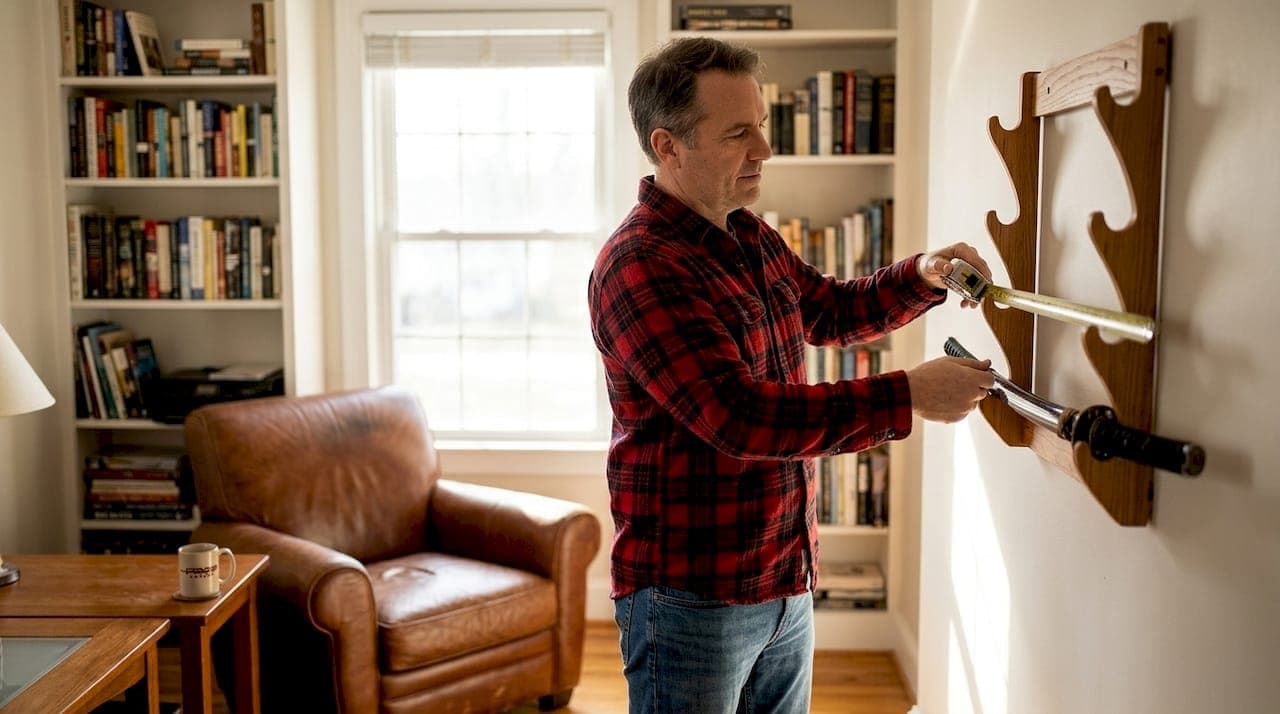
Getting a replica sword onto your wall or shelf feels like the finish line. But the real challenge starts the moment you ask: will it still look this good in five years? Collectors who skip the planning stage often end up with faded finishes, scratched blades, or mounts that pull out of drywall at the worst possible moment. A solid display checklist closes that gap between a stunning showcase and one that actually protects your investment. Whether you collect anime replicas, Viking blades, or fantasy swords, the steps below will help you display smarter.
Table of Contents
- Essential criteria for sword display
- Display options: wall mounts, stands, cases
- Mounting checklist: security and sword protection
- Environmental controls and maintenance tips
- Summary comparison: checklist for popular sword types
- Enhance your sword collection with expert tips
- Frequently asked questions
Key Takeaways
| Point | Details |
|---|---|
| Choose safe locations | Avoid sun, humidity, and high-traffic spots to preserve sword quality. |
| Select the right mount | Wall mounts are ideal for most replicas; use stands or cases for flexibility or preservation. |
| Install anchors securely | Heavy-duty, felt-lined brackets protect blades and reduce display accidents. |
| Maintain environment | Stable humidity and temperature, plus regular cleaning, keep swords looking their best. |
| Adapt care to sword type | Anime/fantasy replicas need less maintenance than historical blades, but all benefit from proper display. |
Essential criteria for sword display
Before you touch a single bracket or drill a single hole, you need to define your display criteria. Think of this as the foundation layer. Every decision you make later, from mount type to lighting, should trace back to these core factors.
Environmental placement is the most overlooked piece. Direct sunlight, high humidity, heat sources, and high-traffic areas are the four biggest threats to any replica sword. UV rays bleach decorative wrappings and fade painted finishes. Humidity causes rust on carbon steel and warps wooden scabbards. Heat cycling causes metal to expand and contract, loosening fittings over time.
Safety is equally non-negotiable. A sword that falls off a wall is a danger to people and a disaster for the blade. Secure mounting is not optional, it is the baseline. Beyond safety, think about thematic context. An anime replica looks best surrounded by related art or figures, while a Viking sword benefits from a more rustic, minimal backdrop.
Here is a quick criteria checklist to run through before you start:
- Location: Away from windows, vents, radiators, and doorways
- Humidity zone: Ideally a climate-controlled room, not a garage or basement
- Traffic level: Low-traffic areas reduce accidental contact
- Visibility: Eye level or slightly above for maximum visual impact
- Thematic fit: Does the display location match the sword's aesthetic?
"The best display is one where the sword is seen, not touched, and protected without looking like it's locked away."
Understanding the display sword benefits goes beyond aesthetics. A well-placed sword becomes a conversation piece, a focal point, and a reflection of your taste as a collector. Once you have your criteria locked in, you can show off your sword collection with confidence instead of guessing.
Display options: wall mounts, stands, cases
Once you have defined your display criteria, it is time to assess which method best fits your collection and space. Each option has real trade-offs, and the right choice depends on your sword type, room layout, and how often you want to interact with the piece.
Wall mounts are the most versatile option for anime and fantasy replicas. They keep swords visible, save floor and shelf space, and let you arrange multiple pieces into a gallery-style layout. Freestanding stands offer flexibility since you can reposition them without tools. Cases offer the best preservation, especially for valuable or historically inspired blades you rarely handle.
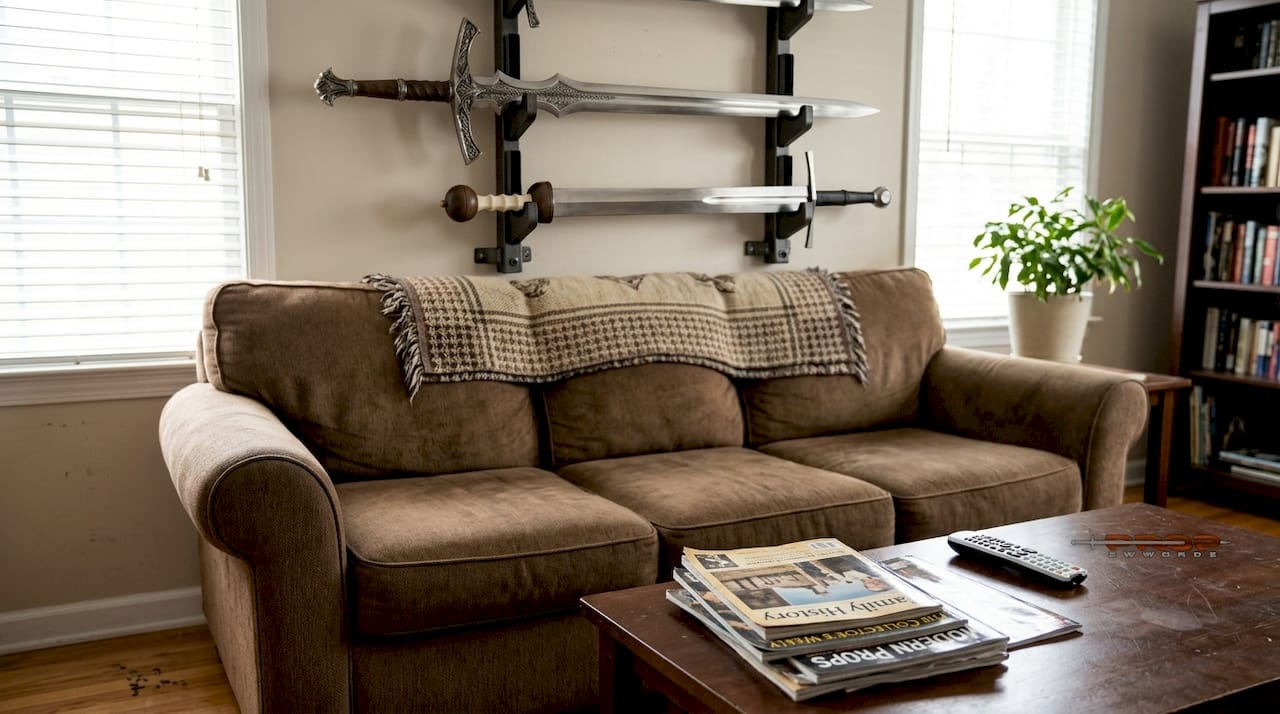
Here is a side-by-side comparison to help you decide:
| Display type | Best for | Pros | Cons |
|---|---|---|---|
| Wall mount | Anime, fantasy, multi-sword setups | Space-saving, high visibility, secure | Requires drilling, fixed position |
| Freestanding stand | Single swords, tabletop displays | No installation, easy to move | Less secure, takes up surface space |
| Display case | Valuable or fragile replicas | Best protection, dust-free | Higher cost, limits visibility |
| Shadow box | Small or decorative pieces | Enclosed, great for themed displays | Not ideal for full-length swords |
For anime collections specifically, wall mounts paired with LED strip lighting create a dramatic effect that cases simply cannot match. Stands work well for rotating displays, where you swap out featured pieces seasonally or after new acquisitions.
- Wall mounts: Best for showcasing multiple swords in a themed arrangement
- Stands: Great for tabletop setups or when you want to handle the sword regularly
- Cases: Ideal when preservation outweighs display drama
Pro Tip: If you collect both anime replicas and historical blades, consider a hybrid setup. Mount the replicas on the wall for visual impact and keep historical pieces in a case for protection.
For more detail on keeping your setup accident-free, the guide to safer sword displays is worth reading before you commit to a method. And if you are still building your collection, the anime sword buying checklist helps you choose pieces that display well from the start.
Mounting checklist: security and sword protection
After picking your display style, it is crucial to ensure your mounting setup is both secure and protective. This is where most DIY displays go wrong. People underestimate the weight of replica swords, skip the stud-finding step, or use brackets without padding. All three mistakes lead to damage.
Anchors rated at 3x sword weight, installed into wall studs, are the gold standard for wall mounts. Felt-lined or padded brackets protect the scabbard and blade from scratches and corrosion at contact points. This is not overkill. Secure mounting reduces accidents by 90%, and improper installation is the most common failure point in home sword displays.
Follow this step-by-step mounting sequence:
- Find the studs using a stud finder. Mark their centers with a pencil.
- Select your brackets based on sword length and weight. Confirm the weight rating.
- Line up the brackets at your desired height. Use a level to confirm alignment.
- Pre-drill pilot holes into the stud centers to prevent wood splitting.
- Attach brackets with screws long enough to bite at least 1.5 inches into the stud.
- Add padding to all contact points using felt strips or foam tape.
- Test the mount by applying downward pressure before placing the sword.
- Place the sword and check that it sits level and stable.
Here is a quick reference for tools and materials:
| Item | Purpose | Recommended spec |
|---|---|---|
| Stud finder | Locate wall studs | Electronic, not magnetic |
| Drill and bits | Pilot holes and screw driving | Variable speed drill |
| Wood screws | Secure brackets to studs | 2.5 to 3 inch length |
| Heavy-duty anchors | Use if studs are not accessible | Rated 3x sword weight |
| Felt or foam tape | Protect blade and scabbard | Self-adhesive, 1/8 inch thick |
| Level | Ensure straight alignment | 24-inch bubble level |
Pro Tip: Weigh your sword before buying brackets. A full-length anime replica can weigh anywhere from 2 to 6 pounds. Always buy brackets rated well above that range, not just at it.
For a deeper look at what separates a safe display from a risky one, the expert sword checklist covers criteria that apply to both replicas and historical pieces.
Environmental controls and maintenance tips
With your swords safely mounted, maintaining their condition depends on a controlled environment and consistent upkeep. The good news is that most anime and fantasy replicas are made from stainless steel, which is far more forgiving than carbon steel. But that does not mean you can ignore maintenance entirely.
Maintain 40 to 60% relative humidity and temperatures between 65 and 75 degrees Fahrenheit for any sword display. Carbon steel blades need oiling every 3 to 6 months using mineral oil or choji oil. Always dust with a soft cloth and avoid touching the blade with bare hands. Skin oils accelerate corrosion, even on stainless steel.
For fantasy and anime replicas, which are often stainless steel or display-only construction, the maintenance priority shifts toward aesthetics and safety rather than battle-ready upkeep. Stainless resists rust far better than carbon steel, but it still benefits from occasional wiping and proper storage conditions.
Here is a practical maintenance checklist:
- Monthly: Dust with a dry microfiber cloth. Check bracket tightness.
- Every 3 months: Wipe stainless blades with a lightly oiled cloth. Inspect scabbard for warping.
- Every 6 months: Oil carbon steel blades with mineral or choji oil. Check humidity levels with a hygrometer.
- Annually: Inspect all mounting hardware for loosening. Re-tighten or replace as needed.
"A sword that is never touched still needs attention. Dust, humidity, and temperature do their damage quietly over months and years."
Handling matters too. Always use cotton gloves when repositioning a sword. A soft cloth between your hand and the blade is the minimum. The sword materials guide explains why different metals react differently to environmental conditions, which is useful if your collection spans multiple blade types.
Summary comparison: checklist for popular sword types
To wrap up, let's compare and clarify checklist differences for the main types of replica swords you might display. The steps are similar, but the priorities shift depending on what you are working with.
| Checklist step | Anime/fantasy replica (stainless) | Historical blade (carbon steel) |
|---|---|---|
| Location | Away from sunlight and humidity | Same, but stricter humidity control |
| Mount type | Wall mount or stand | Wall mount or case preferred |
| Bracket padding | Felt-lined recommended | Essential, no exceptions |
| Climate control | 40 to 60% RH, 65 to 75°F | Same, monitor more frequently |
| Oiling schedule | Optional, every 6 to 12 months | Every 3 to 6 months, required |
| Handling | Cotton gloves preferred | Cotton gloves required |
| Dust removal | Monthly microfiber wipe | Monthly, more careful technique |
The differences between stainless and carbon steel maintenance come down to corrosion risk. Carbon steel is reactive and needs active care. Stainless is more forgiving but still benefits from the same environmental controls.
A few additional points worth noting:
- Anime replicas with decorative wrappings need extra care around the handle. Moisture causes wrapping to loosen and mold.
- Historical-style blades with fuller grooves (the channel running along the blade) collect dust faster and need more thorough cleaning.
- Both types benefit from indirect lighting rather than direct spotlights, which generate heat.
For collectors who display both types, the medieval sword display guide offers specific tips for historical replicas. And if you want to understand the deeper meaning behind your collection, the piece on cultural symbolism of swords adds a fascinating layer to why these pieces matter beyond their appearance.
Enhance your sword collection with expert tips
For collectors ready to put this checklist into action, or seeking even more specialized tips, Propswords has you covered. Whether you are setting up your first wall mount or refining a collection that spans dozens of pieces, the right resources make every step easier.
At Propswords, you will find not just a wide selection of anime, Viking, and fantasy replica swords, but also a growing library of collector guides built specifically for enthusiasts like you. From choosing the right mount to understanding blade materials, the site is designed to support your collection at every stage. Ready to take your display to the next level? Explore the full replica sword display guide and discover how to showcase your collection with confidence. Free shipping within the USA makes it even easier to add your next piece.
Frequently asked questions
What's the best way to mount an anime or fantasy replica sword?
Wall mounts anchored into studs with heavy-duty, felt-lined brackets offer the best security and visual impact for anime and fantasy replicas. They keep the sword visible, stable, and protected at all contact points.
How do I prevent sword rust and corrosion?
Maintain 40 to 60% humidity and steady temperatures, oil carbon blades every 3 to 6 months, and always handle blades with cotton gloves to avoid transferring skin oils.
Can I display swords in a room with lots of natural light?
It is best to avoid direct sunlight, as UV rays damage finishes and accelerate corrosion. Choose shaded placement or use indirect lighting to highlight the sword without exposing it to harmful rays.
What tools do I need for secure sword mounting?
You will need a stud finder, a drill, anchors rated at 3x sword weight, felt-lined brackets, wood screws, and a level to ensure everything is straight and secure before placing the sword.